Evening Relaxation: How to Light Your Garden Bench Area Without Electricity
October 09, 2026 - Evening Relaxation

October 04, 2026 - Outdoor Seating
The best hour in a garden is the one after sunset. The air cools, the birds go quiet, and a bench that looked ordinary all afternoon becomes somewhere you could stay for another hour. Reaching for a switch spoils it: floodlights flatten everything and a white bulb turns leaves grey. What you want is a small, warm pool of light — enough to see your glass and your book, with the rest of the garden left to the dark. No wiring required.
Sit on the bench at dusk before you buy anything. Notice where your hands go, because that is where light is needed: a table top, a book, the path back to the door. Everything else can stay dark.
Two rules separate a garden that feels lit from one that feels like a car park. Keep sources below eye level — around 60cm or lower for anything close — because light at eyeline glares and makes you squint rather than settle. And stick to warm white, roughly 2200K to 2700K, the amber of candlelight. The cool 6000K LEDs sold as daylight will make your planting look grey and your skin worse.
It also helps to decide what the light is for. A reading lamp needs to fall on the page, not into your eyes. A table light needs to show the rim of a glass and the label on a bottle. A path light needs to mark the edge of a step without turning the whole route into a runway. When you know the job, you can choose a smaller lamp and place it more precisely. Often one low light behind the bench is enough to silhouette the planting and make the seat feel like a room.
Solar garden lighting varies enormously. Cheap stake lights give a soft two or three hours; better ones run to midnight and then dim. The biggest factor is not the lamp but the panel.
A panel shaded by a fence or overhanging shrub will never collect enough charge, no matter how many LEDs the lamp has. The lamp can sit in the shade where you need it, but the panel must see direct sun for most of the day. Look for a model with a separate panel on a cable, or one where the panel can be detached and angled. In the northern hemisphere, aim the panel south; in the southern hemisphere, aim it north. Tilt it toward the sun rather than leaving it flat, and wipe it clean every few weeks — dust, pollen and bird mess cost you charging time.
A useful test: if the panel is in shadow at noon, the lamp will be dim by nine. I have seen a solar stake light pushed into a border under a shrub die before the first glass was finished. The same lamp, with its panel cable-tied to a sunny fence post, still glowed at midnight. Position is almost everything.
For a bench area, 10 to 50 lumens is plenty. More than that and you are lighting the garden, not the seat. Choose a frosted diffuser or a shielded fixture so you see the glow, not the LED point. If you can see the tiny bright dot from where you sit, it will glare. A downward-facing lantern, a small table lamp with a warm bulb, or a solar lantern with a amber mode will all work better than a bright stake light aimed at your face.
Solar lamps live or die by their batteries. NiMH cells are common and cheap to replace; lithium holds charge better in cold weather. Run-time claims are usually measured in summer, with a full day of sun. In winter, expect half the hours or less. A 20-lumen lamp with a modest battery might run four to six hours in July and two hours in December. If you want reliable light in winter, treat solar as a summer pleasure and keep a rechargeable backup for the darker months.
You do not need sun to avoid wiring. A small camping lantern with a warm mode, charged indoors during the day, can sit on the ground behind the bench and throw a soft wash upward. A rechargeable table lamp, the kind sold for balconies and tents, does the same job with more style. USB fairy lights are another option, but choose warm white and keep them low — wrapped around a bench leg, not strung across the whole garden. A power bank in a dry tin can run a low-output lamp for several evenings, and it costs nothing to recharge indoors.
The advantage of rechargeable light is control. You can carry it out when you need it, dim it, and take it in when the weather turns. The disadvantage is that you have to remember to charge it. A simple routine helps: bring the lantern in with the wine glasses, plug it in by the door, and it will be ready the next evening.
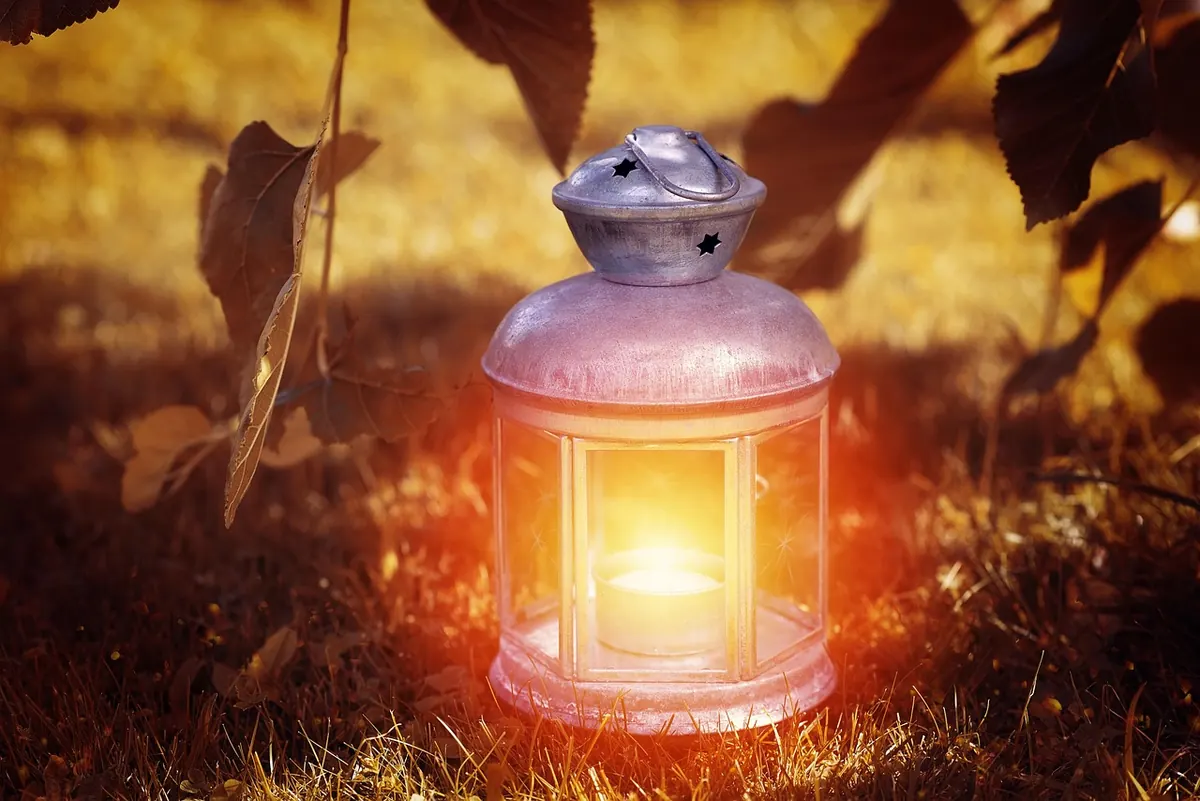
Nothing beats a flame for warm, low light. A beeswax candle in a glass hurricane gives a steady amber glow and a faint honey scent. An oil lamp with a frosted chimney is brighter and more practical for reading, though it needs trimming and decent fuel. A small fire bowl or chiminea can extend the evening, but it is not a bench light — it is a separate gathering point, and it needs space, dry fuel and constant attention.
Safety matters more than atmosphere. Never leave a flame unattended. Keep candles and oil lamps on stable, heatproof surfaces, away from dry grass, fallen leaves and low branches. Check local rules about open fires. And do not use a candle where children or pets will knock it. If in doubt, choose a rechargeable lantern with a flicker mode — it gives the feeling without the risk.
The most restful garden lighting is layered. Instead of one bright lamp, use two or three tiny ones, each with a separate job. Put a small warm light on the table for your book. Tuck another under the bench seat so the gravel below catches a soft edge. Place a third low on the path, aimed down at the step. The dark spaces between them are not a problem; they are what give the scene depth.
Try to avoid symmetry. If both sides of the bench are lit equally, the eye reads it as a stage. One stronger pool and one weaker glow feel more natural. You can also use a screen — a piece of slate, a small stone, a folded metal sheet — to hide the source and throw light only where you want it. This is the oldest trick in lighting: show the effect, hide the lamp.
The point of a garden bench after sunset is not to banish the night. It is to make a small, comfortable place inside it. If you can see the bulb from where you sit, move it. If the light reaches the far fence, shield it or dim it. If a white light is spilling from the house, close a curtain or switch it off. Your eyes will adapt, and the garden will become larger, not smaller.
The goal is not to light the garden. It is to light the bench.
Do that, and you will stay out longer. The tea goes cold, the book stays open, and the dark does the rest.
Photo: Pezibear / Pixabay
Choose a bench spot by matching it to the hours you'll actually use it: evening sun, shelter from prevailing wind, a...
Make the most of a small balcony with folding benches, wall-mounted seats and clever compact layouts that keep the...
Copyright © 2026 Dusk Bench. All Right Reserved.